
Quick Answer
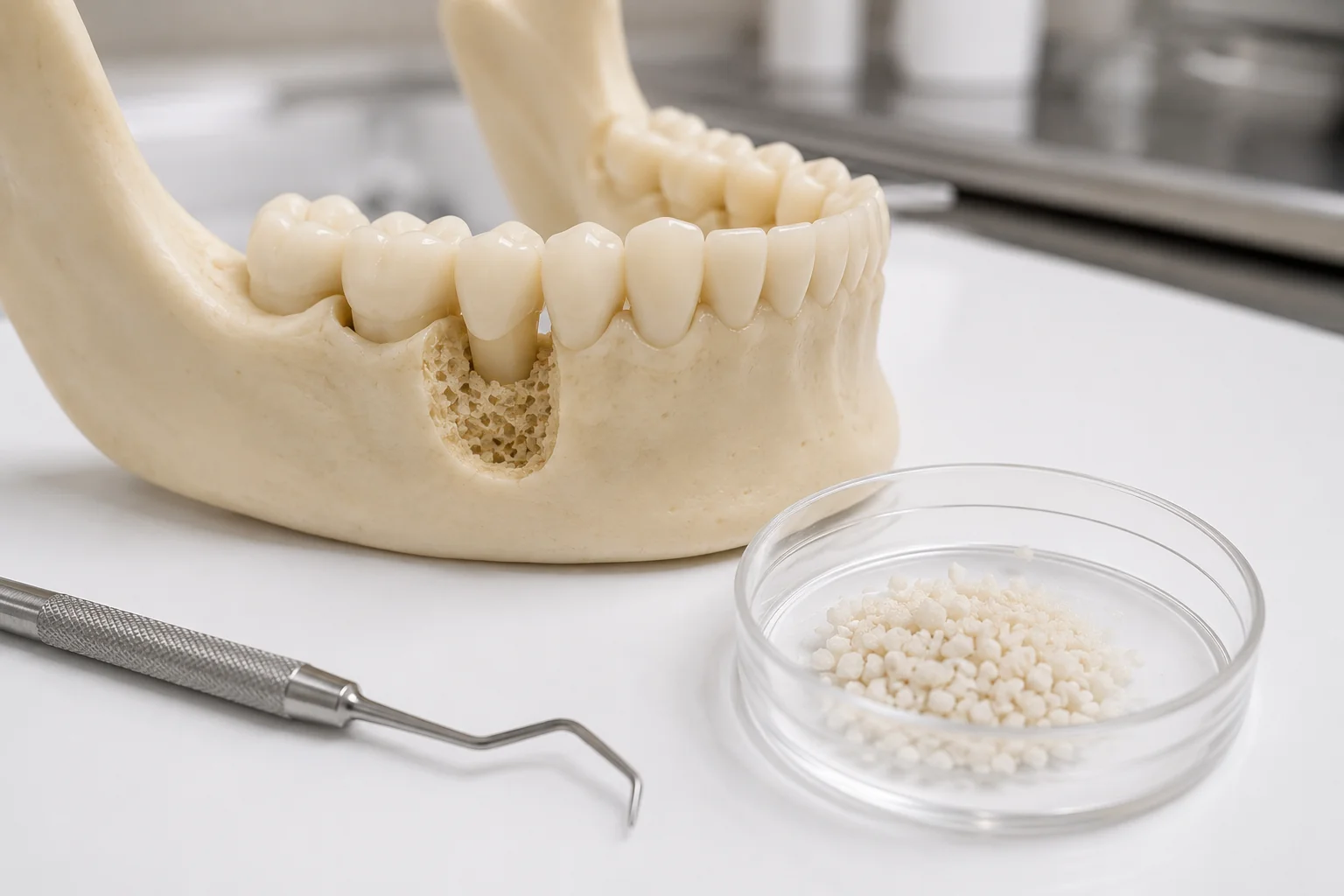
Dental bone grafting is the procedure that adds bone material to your jaw when there is not enough natural bone to support a dental implant. It is needed when a tooth has been missing for a long time (jaw bone shrinks without a tooth root stimulating it), after gum disease, after trauma, or before placing implants in the upper back jaw where the sinus floor sits close to the bone surface. Most grafts heal in 4 to 6 months, and the implant is then placed in the rebuilt bone. Long Island costs typically run $300 to $1,200 per grafted site, sometimes covered by PPO insurance when medically necessary.
“You need a bone graft before we can place your implant” is one of the most common surprises patients hear at their first implant consultation. The good news: bone grafting is a well-established procedure, the materials and techniques have improved dramatically over the last two decades, and almost every patient who needs a graft can get to a successful implant outcome.
This guide walks through why grafts are needed, what the procedure actually involves, what to expect during healing, the costs in the Long Island metro, and the specific approach Dr. Timur Mozner uses at Creative Dental of Syosset.
Why Bone Grafts Are Needed
Dental implants depend on bone for stability. When a titanium implant is placed in the jaw, the bone fuses to it in a process called osseointegration over 3 to 6 months. If there is not enough bone (in height, width, or density) at the implant site, the implant cannot integrate reliably. The fix, in most cases, is to add bone first.
The most common reasons patients need grafts:
- A tooth has been missing for months or years. Without the chewing forces transmitted through a tooth root, the surrounding bone slowly resorbs (shrinks). After 1 year of a missing tooth, you may have lost up to 25% of the bone width. After 5 years, the bone in that area can be substantially reduced.
- Gum disease (periodontitis) has destroyed bone. Advanced gum disease eats away at the bone supporting the teeth. Even after the disease is treated, the lost bone does not grow back without intervention.
- Trauma or infection. A fractured or knocked-out tooth often takes surrounding bone with it. Untreated dental abscesses can also cause significant bone loss.
- Tooth extraction site collapse. Without immediate intervention (called “socket preservation” or “ridge preservation”), the bone where a tooth was removed shrinks within weeks.
- Sinus pneumatization in the upper back jaw. The maxillary sinus naturally expands downward as the upper molars are lost, leaving very thin bone between the sinus and the implant site. This is the most common indication for a sinus lift, a specialized type of bone graft.
- Anatomical variation. Some patients are simply born with thin jaw bone in certain areas.
Types of Bone Graft Material
Modern dentistry uses several categories of grafting material, each with its own advantages:
- Autograft (your own bone). Bone harvested from another site in your mouth (chin, behind the wisdom teeth, the ramus of the lower jaw) or, for larger cases, the hip. Considered the gold standard for predictability but requires a second surgical site.
- Allograft (donor human bone). Sterilized and processed human bone from a tissue bank. Eliminates the second surgical site and is widely used for routine implant grafts.
- Xenograft (animal-source bone). Most commonly bovine (cow). Highly porous structure that the body uses as a scaffold for new bone formation. Bio-Oss is a well-known example.
- Alloplast (synthetic). Engineered materials including hydroxyapatite, calcium phosphates, and bioactive glass. Predictable, available in any quantity, no biological source.
At Creative Dental of Syosset, Dr. Mozner is direct about the scope: “Bone grafting of a high quality bioadaptable material. It only works in limited situations.” Translation: the bioadaptable material his office uses is excellent for routine socket preservation and small-to-moderate ridge augmentation, but larger defects (severe bone loss, congenitally missing teeth, post-traumatic ridges) sometimes call for autograft, block grafts, or referral to an oral surgeon. The choice of material depends on the size of the defect, the location, and the patient’s specific situation, and is determined after the CBCT scan during your consultation.
Types of Bone Graft Procedures
Several distinct grafting procedures handle different anatomical situations:
Socket Preservation (Ridge Preservation)
Performed at the time of tooth extraction. The graft material is placed into the empty socket immediately after the tooth is removed, preventing the bone collapse that normally happens in the weeks after extraction. This is the simplest, fastest, and most predictable form of grafting and dramatically reduces the need for larger grafts later.
Ridge Augmentation
Performed when bone has already been lost and needs to be rebuilt before an implant can be placed. The graft material is placed against the existing bone and covered with a membrane that protects it during healing. New bone forms in 4 to 6 months.
Sinus Lift (Sinus Augmentation)
Performed in the upper back jaw when the maxillary sinus has expanded downward and there is not enough bone height for an implant. The sinus membrane is gently lifted, graft material is placed in the space, and new bone forms in 4 to 9 months. There are two main approaches: lateral window (larger graft, more bone gained, longer recovery) and crestal/transalveolar (smaller graft, less invasive, used when only a small amount of bone is needed).
Block Grafts
For larger defects where a small amount of grafting material would not be enough, a small block of bone (usually autograft from the chin or jaw) is screwed into place. Used in cases of severe bone loss, traumatic defects, or congenitally missing teeth where the ridge is significantly underdeveloped. Block grafts heal in 4 to 6 months before implant placement.
Guided Bone Regeneration (GBR)
Often used in conjunction with the procedures above. A resorbable or non-resorbable membrane is placed over the graft material to keep soft tissue from invading the graft site, allowing only bone-forming cells to populate the area.
What to Expect During the Procedure
For routine socket preservation or small ridge augmentation, the procedure is straightforward and comparable to a standard tooth extraction or implant placement in terms of complexity and recovery:
- Local anesthesia. The site is fully numbed. Patients with anxiety can request nitrous oxide or other sedation options.
- Access. A small incision in the gum exposes the bone where grafting is needed.
- Site preparation. Any infected or damaged tissue is cleaned. The bone surface is prepared to receive the graft.
- Graft placement. The grafting material is shaped and packed into the defect.
- Membrane placement (when used). A thin membrane is placed over the graft to protect it during healing.
- Closure. The gum is closed with sutures.
Total chair time for a routine graft: typically 30 to 60 minutes. Larger grafts (block grafts, sinus lifts) take longer (60 to 120 minutes).
Healing and Recovery
The post-operative experience is similar to a tooth extraction:
- First 24 to 48 hours: Mild to moderate discomfort manageable with ibuprofen. Some swelling. Soft food diet. Cold compresses to the outside of the face for the first 24 hours.
- Days 3 to 7: Discomfort fading. Soft to medium-soft food. Avoid the surgical site when brushing.
- Weeks 1 to 2: Sutures usually removed at the 1-week follow-up. Most patients are back to normal function.
- Weeks 4 to 6: Soft tissue fully healed. Bone is still in early remodeling.
- Months 4 to 6: Bone fully matured. Implant placement can proceed.
- Months 6 to 9 (sinus lifts only): Sinus grafts may need slightly longer healing before implant placement.
Common post-op care:
- Soft diet for 1 to 2 weeks
- No spitting, smoking, or using straws for the first several days (negative pressure can dislodge the clot or graft)
- Salt water rinses starting 24 hours after surgery
- Antibiotics to prevent infection (prescribed routinely for grafts)
- No heavy exercise for 3 to 5 days
- Sleeping with head elevated for the first 2 to 3 nights
What Bone Grafts Cost in Long Island
Pricing varies significantly with the size and type of graft. Long Island metro ranges:
- Socket preservation (at the time of extraction): $300 to $700 per site
- Small ridge augmentation: $400 to $1,000 per site
- Larger ridge augmentation: $800 to $1,500 per site
- Crestal sinus lift: $1,000 to $2,500
- Lateral window sinus lift: $1,500 to $3,000+
- Block graft: $1,500 to $3,500 per site
Insurance coverage is mixed. Most PPO dental plans cover bone grafting when it is medically necessary as part of a treatment plan, though coverage often counts against your annual maximum and may have limitations on graft type. Medicare typically does not cover dental bone grafts. Creative Dental of Syosset works with PPO plans and offers CareCredit financing for the patient portion.
At Creative Dental of Syosset, every step, from your cleaning to a complex implant, is performed by one doctor in one boutique office. Dr. Timur Mozner is a NYU dental school faculty member and 3x America’s Best Dentist who has placed over 3,000 implants and 300 veneers in his Syosset practice.
Dr. Timur Mozner, DDS, Creative Dental of Syosset
When You Might Not Need a Graft
Not every implant case requires grafting. Patients who can often skip grafting:
- Recent extractions where the bone is still intact. If the implant can be placed at the same time as the extraction or shortly after, grafting is sometimes unnecessary.
- Patients with strong, dense jaw bone in the implant site
- Cases where a 3D CBCT scan confirms adequate bone height, width, and density
This is why a CBCT scan is the first step in any implant evaluation. The 3D imaging shows whether the bone is adequate or whether a graft will be needed, before any treatment plan is finalized.
Creative Dental of Syosset
Creative Dental of Syosset is a boutique single-doctor dental practice at 34 S Oyster Bay Rd, Syosset, NY 11791. Dr. Timur Mozner, DDS, has been performing dental implant procedures in Syosset for over 20 years, with more than 3,000 implants placed at a 96% success rate. He completed his bone and membrane grafting certification with NOBEL in 2008 and has been Main Clinical Supervising Faculty at NYU Dental School since 2020. The office serves patients from Syosset, Oyster Bay, Woodbury, Jericho, Plainview, Hicksville, Bethpage, Old Bethpage, Massapequa, Greenvale, Glen Head, Glen Cove, and across Nassau County.
If your dentist has told you that you may need a bone graft before an implant, schedule a consultation. We will review your CBCT imaging, explain exactly what is needed in your case, and walk through the cost, timeline, and treatment plan.
Schedule an Implant Consultation
Or call (516) 921-3290
Frequently Asked Questions
How long after a bone graft can I get my implant?
Most routine grafts heal sufficiently for implant placement in 4 to 6 months. Sinus lifts may require 6 to 9 months. Socket preservation grafts at the time of extraction sometimes allow implant placement in as little as 3 to 4 months. The CBCT scan at the follow-up confirms that the new bone is mature enough.
Are bone grafts painful?
The procedure itself is performed under local anesthesia and is not painful. Post-operative discomfort is mild to moderate for the first 1 to 3 days and is typically managed with over-the-counter ibuprofen. Most patients describe the experience as comparable to a standard tooth extraction.
Will my body reject a bone graft?
Rejection is rare. Modern grafting materials (allograft, xenograft, synthetic) are processed to remove cellular components that would trigger an immune response. The body uses the graft as a scaffold for new bone formation. Failure (when it occurs) is more often related to infection, smoking, uncontrolled diabetes, or premature loading rather than rejection.
Does smoking affect bone graft success?
Yes, significantly. Smoking reduces blood supply to the graft site, impairs healing, and dramatically increases failure rates. Patients who smoke are usually asked to stop or significantly reduce smoking before and during the healing period. Many surgeons consider active smoking a relative contraindication for elective grafting.
What happens if a bone graft fails?
If a graft does not integrate properly, it can usually be re-done after the site is allowed to heal. Failure is uncommon (5 to 10% in most published series) and is identified at follow-up imaging. The implant is not placed until the graft is confirmed successful.
Is bone grafting covered by insurance?
Most PPO dental plans cover bone grafting when it is medically necessary as part of a treatment plan, though coverage usually counts against your annual maximum and may have limitations on graft type. Medicare typically does not cover dental bone grafts. We verify coverage and discuss costs upfront.
This information is provided for educational purposes and is not a substitute for professional medical advice, diagnosis, or treatment. Please schedule a consultation with our team to discuss your individual needs.