
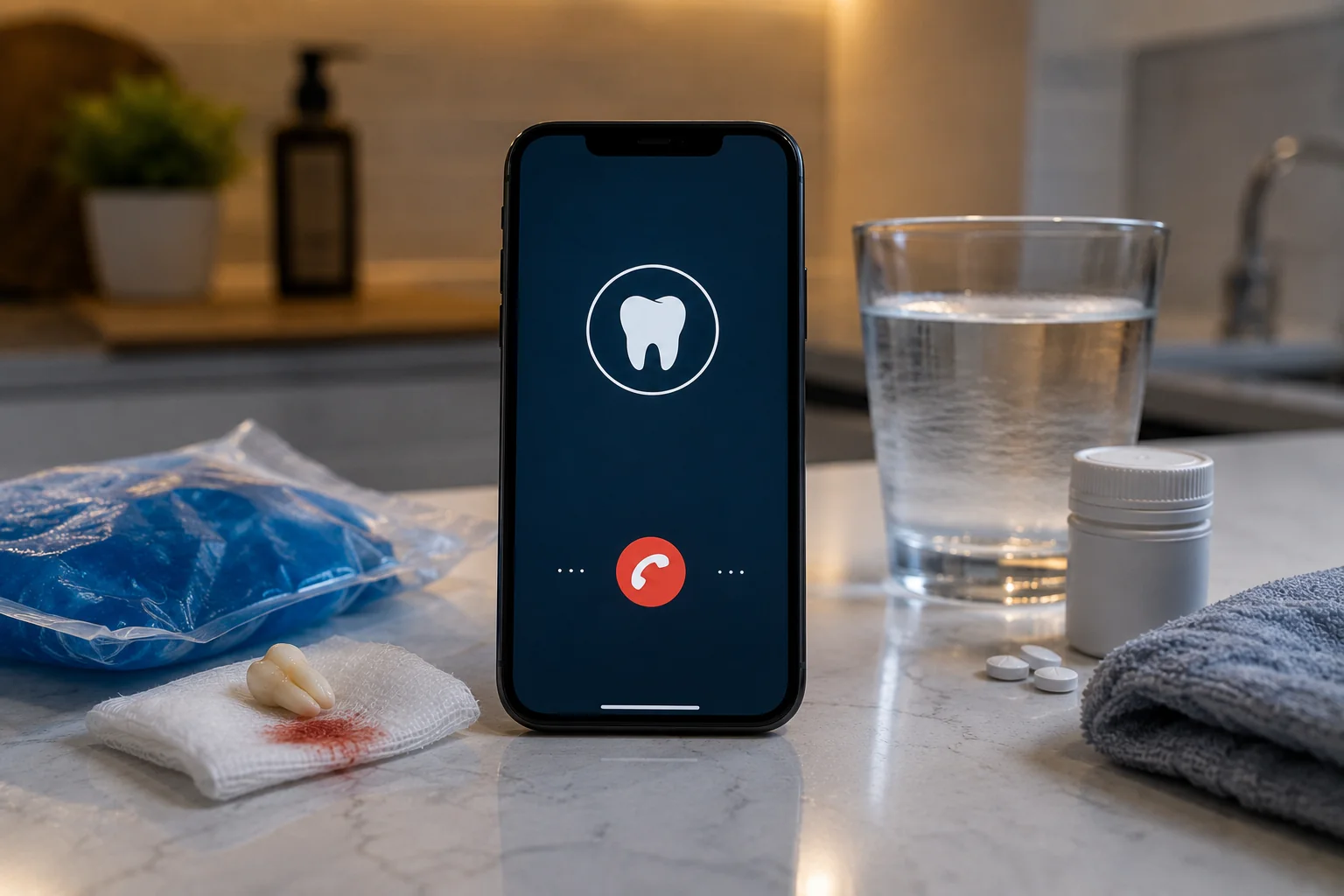
Quick Answer
Most dental emergencies (knocked-out tooth, severe toothache, broken filling or crown, abscess, lip or gum injury, jaw pain) should go to your dentist, not the ER. Hospital ERs typically do not provide dental treatment beyond pain control and antibiotics, so a dentist is what actually fixes the problem. Go to the ER first only when bleeding cannot be controlled with pressure, when there is significant facial swelling that is affecting breathing or vision, after major facial trauma, or when there are signs of serious infection like fever and difficulty swallowing. Creative Dental of Syosset has a 24/7 emergency line at (516) 921-3290, same-day appointments, and Saturday hours.
Dental emergencies almost always happen at the worst possible time, late on a Saturday night, on a holiday weekend, or right before an important event. The instinct to go to the emergency room is understandable, but in most cases the ER cannot actually fix the problem. They can manage pain and prescribe antibiotics, but they do not place crowns, do not perform root canals, do not re-implant knocked-out teeth, and do not extract wisdom teeth. Knowing what counts as a dental emergency, what your dentist can handle, and when the ER is genuinely the right choice can save you a long and expensive night.
This guide covers the common dental emergencies, what to do in the first hour, when the ER is needed first, and how Creative Dental of Syosset handles emergency calls in Syosset and across Nassau County.
What Counts as a Dental Emergency
The clearest dental emergencies, in rough order of urgency:
- Knocked-out permanent tooth (avulsion). Time is critical. Re-implantation in the first 30 minutes has the highest success rate. After 60 minutes, success drops sharply.
- Severe, escalating toothache with throbbing, sensitivity to hot or cold, and swelling. Often a sign of an infected nerve or abscess.
- Dental abscess, especially with facial swelling, fever, or a bad taste from a draining sore. Abscesses can spread to deeper neck spaces and become life-threatening if ignored.
- Broken or chipped tooth with sharp edge or exposed nerve. Pain plus the risk of further fracture.
- Lost crown, filling, or bridge, particularly if the underlying tooth is sensitive or the lost piece can be swallowed or aspirated.
- Lip, gum, tongue, or cheek injury with significant bleeding.
- Jaw pain or jaw dislocation, especially if you cannot fully open or close your mouth.
- Uncontrolled bleeding after an extraction or injury.
- Object stuck between teeth that floss and gentle picking cannot remove.
- Loose adult tooth from trauma or sudden mobility.
Common things that feel urgent but usually are not true emergencies (call your dentist for a same-day or next-day appointment, not the ER):
- A loose baby tooth in a child
- A small chip with no pain or sharp edge
- Mild gum irritation
- A loose orthodontic bracket or wire (uncomfortable but not urgent)
- A dull, intermittent toothache that has been present for weeks
When to Go to the ER First
The ER is the right first stop in a small number of true medical emergencies that happen to involve the mouth or face:
- Bleeding that cannot be controlled with 20 minutes of firm pressure
- Significant facial swelling that affects breathing, swallowing, or vision
- Major facial trauma (motor vehicle accident, sports impact, fall) where you may have a broken jaw, broken eye socket, or other facial fractures
- High fever, chills, and severe swelling under the jaw or in the throat, which can indicate a serious deep-space infection (Ludwig’s angina)
- Loss of consciousness, vomiting blood, or signs of head injury after any oral or facial trauma
- Difficulty breathing or swallowing from any cause
In these cases, the ER stabilizes you, gets imaging, controls bleeding and pain, and refers you to a dentist or oral surgeon for the dental treatment itself. This is the appropriate sequence: ER first, dentist second.
What to Do in the First Hour
For the most common emergencies, the steps in the first 60 minutes can change the outcome significantly:
Knocked-Out Permanent Tooth
- Pick up the tooth by the crown (the top), never the root.
- If dirty, rinse gently with milk or saline. Do not scrub. Do not use soap or alcohol.
- If possible, immediately place the tooth back into the socket and gently bite on a clean cloth to hold it in place.
- If you cannot replace it, store the tooth in a small container with cold milk, saline, or saliva. Do NOT store it in water (which damages the root cells).
- Get to a dentist within 30 to 60 minutes. The faster, the better.
Severe Toothache
- Rinse with warm salt water (one teaspoon of salt in a cup of warm water).
- Floss gently around the painful tooth to remove any trapped food.
- Take over-the-counter ibuprofen as directed (if cleared by your physician).
- Apply a cold compress to the outside of your cheek if there is swelling.
- Call your dentist for a same-day appointment.
- Avoid placing aspirin directly on the gum (it burns the tissue).
Broken or Chipped Tooth
- Rinse your mouth with warm water.
- Save any large fragments in milk or saliva (your dentist may be able to bond them back).
- Apply gauze to bleeding areas and use cold compresses outside the cheek to reduce swelling.
- Avoid chewing on the affected side.
- Call your dentist promptly for evaluation.
Lost Crown or Filling
- Save the crown or filling if you can find it.
- Avoid eating sticky or hard foods on that side until repaired.
- Over-the-counter dental cement (available at most drugstores) can temporarily protect a sensitive tooth until you reach the dentist.
- Schedule a dentist appointment within 24 to 48 hours.
Dental Abscess (Swelling, Pain, Fever)
- Rinse with warm salt water.
- Apply a cold compress to the outside of your face.
- Take ibuprofen as directed.
- Call your dentist immediately, or go to the ER if there is significant facial swelling, fever, or difficulty swallowing.
- Do NOT try to “pop” or drain the abscess yourself.
Why the Dentist (Usually) Beats the ER
Most hospital emergency departments do not have dental equipment, do not have dental X-ray capabilities (let alone CBCT), and do not have dentists on staff. What ERs typically provide for a dental emergency:
- Pain management (often opioids for severe pain)
- Antibiotics for infection
- Bleeding control
- Imaging if there is suspected facial fracture
- A referral to a dentist for actual treatment
What ERs almost never provide:
- Re-implantation of a knocked-out tooth
- Root canal treatment
- Tooth extraction (except in rare cases involving an oral surgeon on call)
- Crown or bridge repair
- Dental imaging beyond a panoramic if the hospital has it
So a typical “dental ER visit” looks like this: a 4-hour wait, a prescription for antibiotics and painkillers, and a recommendation to see a dentist within 24 to 48 hours. The actual dental problem is unchanged. The bill, however, is significantly higher than a same-day dentist visit.
Our painless-dentistry protocol combines nitrous oxide, advanced topical numbing, slow injection technique, noise-canceling headphones, and Netflix to keep you comfortable. Patients come from across Nassau County for the boutique, single-doctor environment.
Dr. Timur Mozner, DDS, Creative Dental of Syosset
After Hours, Weekends, and Holidays
One of the biggest sources of dental-emergency-to-ER visits is timing. The accident happens at 8 PM on a Friday, the practice is closed, the answering machine plays, and the patient defaults to the hospital. The fix for this is having a dentist who actually answers after-hours calls.
Creative Dental of Syosset operates a 24/7 emergency phone line at (516) 921-3290. The office is also open Saturdays from 9 AM to 3 PM, which catches most of the weekend emergencies that other practices forward to a hospital. For after-hours and Sunday emergencies, the on-call line directs urgent cases to the right next step, whether that is a same-day appointment first thing in the morning, an immediate office visit, or a referral to the ER if the situation requires it.
How to Avoid a Dental Emergency in the First Place
Most dental emergencies trace back to one of three avoidable causes:
- Skipped routine cleanings. A small cavity caught at a 6-month checkup is a 30-minute filling. The same cavity ignored for 3 years can become an abscess requiring a root canal, a crown, or an extraction.
- Sports without a mouthguard. Custom mouthguards from your dentist prevent the majority of sports-related dental injuries and cost a fraction of what the resulting emergency treatment would.
- Chewing ice or hard foods. Cracked teeth from biting hard foods, ice cubes, popcorn kernels, or non-food objects are one of the most common emergencies. The fix is awareness, not equipment.
Patients who keep their 6-month cleaning schedule and address small problems when they are small almost never end up in an emergency situation.
Creative Dental of Syosset
Creative Dental of Syosset is a boutique single-doctor dental practice at 34 S Oyster Bay Rd, Syosset, NY 11791. Dr. Timur Mozner, DDS, is the Main Clinical Supervising Faculty at NYU Dental School (since 2020) and a 3-time recipient of America’s Best Dentists. The office serves patients from Syosset, Oyster Bay, Woodbury, Jericho, Plainview, Hicksville, Bethpage, Old Bethpage, Massapequa, Greenvale, Glen Head, Glen Cove, and across Nassau County. Office hours: Mon and Wed 10 AM to 6 PM, Tue and Thu 9 AM to 6:30 PM, Fri 10 AM to 3 PM, Sat 9 AM to 3 PM. The 24/7 emergency line is (516) 921-3290.
If you are experiencing a dental emergency, call us first. Same-day appointments are available, and our after-hours line will direct you to the right next step.
Book a Same-Day Appointment
Or call our 24/7 emergency line at (516) 921-3290
Frequently Asked Questions
Should I go to the ER for a knocked-out tooth?
Only if the trauma is severe (head injury, major facial fractures, uncontrolled bleeding). For an isolated knocked-out tooth, your best chance of saving the tooth is getting to a dentist within 30 to 60 minutes. The ER will typically provide pain control and refer you to a dentist anyway.
Will my dental insurance cover an emergency visit?
Most PPO dental plans cover emergency exams and basic emergency procedures (extractions, simple fillings) at standard coverage rates. Major procedures like crowns, root canals, or implants done as part of emergency treatment are covered at the same rate as scheduled procedures. Coverage details vary by plan; we verify benefits at intake.
What if my emergency happens late at night or on a Sunday?
Call our 24/7 emergency line at (516) 921-3290. The on-call protocol will direct you to a same-day appointment first thing the next morning, an immediate office visit if warranted, or to the ER if the situation requires it.
Is a chipped tooth always an emergency?
Not always. A small chip with no pain and no sharp edge can usually wait a few days for a regular appointment. A chip with pain, an exposed nerve, a sharp cutting edge, or a large fracture is an emergency and should be seen the same day.
How much does an emergency dental visit cost?
Emergency exam fees in the Syosset area typically run $75 to $200, plus the cost of any treatment performed (X-rays, fillings, extractions, root canals, antibiotics, etc.). Most PPO plans cover the exam and standard treatment at normal coverage rates. We discuss costs and confirm insurance coverage before any treatment.
What should I bring to a dental emergency appointment?
Your insurance card, a photo ID, a list of any current medications, and any tooth fragments, lost crowns, or lost fillings if you have them. If pain is severe, take any prescribed medication or over-the-counter pain reliever as directed before arriving.
If you are looking for an emergency dentist in Syosset, Creative Dental of Syosset takes same-day calls at (516) 921-3290.
This information is provided for educational purposes and is not a substitute for professional medical advice, diagnosis, or treatment. Please schedule a consultation with our team to discuss your individual needs.